
What to Check Before Buying a Used Semi-Trailer
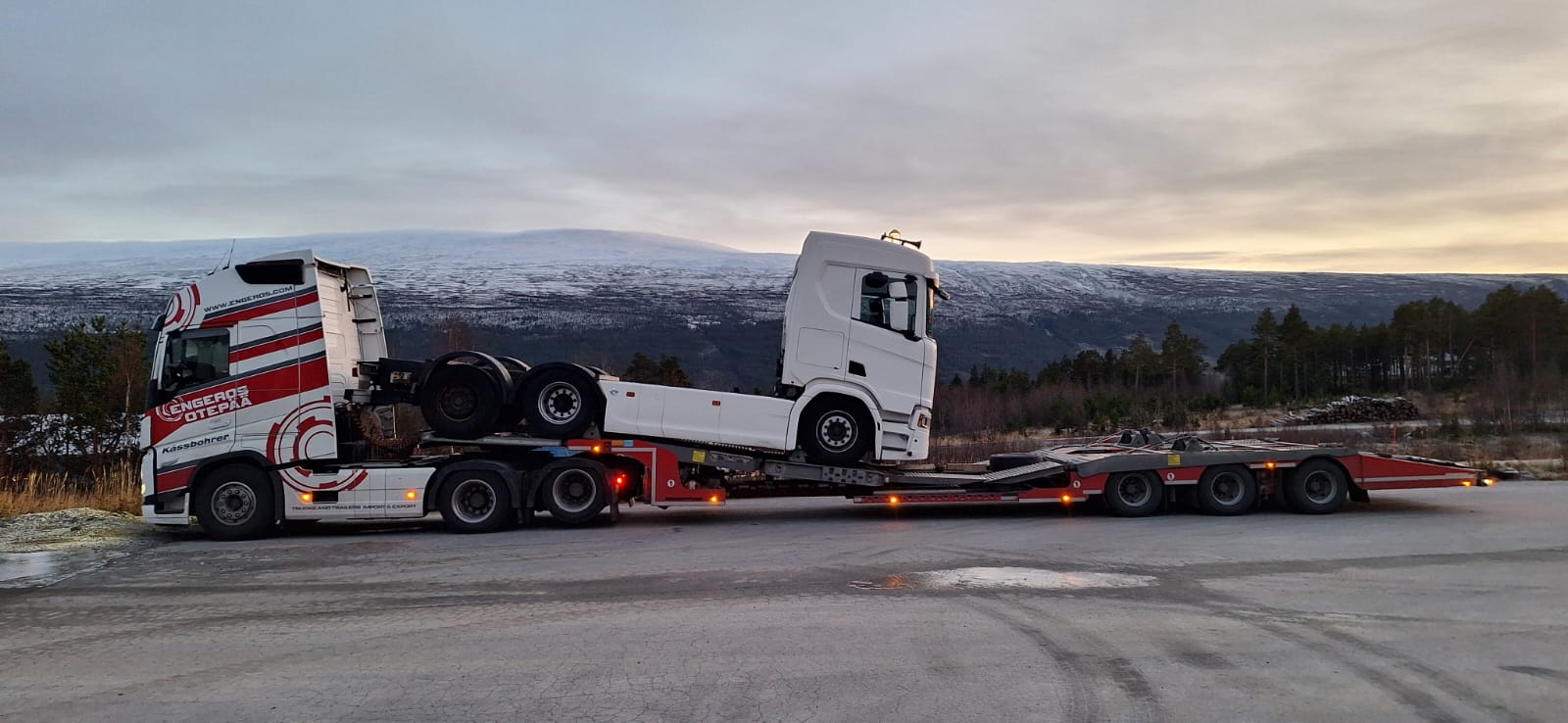
A trailer that needs new tyres is not necessarily a poor purchase. A trailer with unexplained tyre wear is a different proposition: you need to establish whether replacing the tyres will solve the problem or merely hide it temporarily.
That distinction runs through a useful pre-purchase inspection. The aim is not to find a used semi-trailer without any wear. It is to establish whether it suits your work, identify the repairs you can realistically budget for and investigate anything that could change the cost or viability of the purchase.
This guide explains what you can check during a walk-around, which evidence to request from the seller and when a workshop assessment should come before price negotiations.
Before the Inspection: Confirm That It Is the Right Trailer
Start with the specification and identity, not the paintwork. Check the VIN against the identification plate and registration documents, then confirm permitted weights, axle ratings, actual unladen weight, dimensions and coupling compatibility with your tractor unit.
A trailer can be mechanically sound and still be wrong for your business. Machinery may fit on a low-loader's deck but exceed the ramps' permitted loading. A container chassis may carry the container length you need but not support the intended loading arrangement. A large box body does not, by itself, establish a suitable legal payload.
Ask for the relevant specification or manufacturer's documentation where an advertised capacity matters to your purchase. Do not assume that the overall weight rating also establishes the capacity of the floor, ramps or individual securing points.
A Practical Inspection Order
Use this order to avoid spending time pricing minor repairs before discovering a more important limitation:
- Identity and suitability: confirm the documents, intended cargo, coupling and loading requirements.
- Structure and coupling: identify frame damage, questionable repairs, kingpin wear and landing-leg problems.
- Running gear and brakes: assess tyres, hubs, suspension, braking evidence and electrical operation.
- Body and equipment: inspect the floor, weather protection and whichever specialist systems are fitted.
- Purchase decision: separate confirmed repair costs from unresolved faults, then agree the work and handover terms.
Inspection safety: inspect only what is safely accessible. Do not crawl beneath an air-suspended trailer unless it is properly supported for the work. Raised ramps and other equipment also require appropriate securing and support. Leave lifting, wheel-play checks and work beneath the trailer to a qualified workshop with suitable equipment.
1. Frame, Kingpin and Landing Legs: Establish the Repair Scope
The frame is a sensible place to start because structural uncertainty can change the entire purchase calculation. Examine visible frame rails, crossmembers and mounting areas for cracks, distortion and corrosion, paying particular attention to suspension attachments and the structure around the coupling.
Surface rust is not the same as deep corrosion weakening a load-bearing member. Similarly, an added plate or a previous weld is not automatically evidence of an unacceptable repair. What matters is why the work was necessary, how it was completed and whether the repaired structure is suitable for its intended service.
Fresh paint answers none of those questions. Where repairs are visible, request supporting records and a structural assessment rather than treating a tidy finish as proof of condition.
The kingpin and upper coupling plate deserve their own check. A worn kingpin and a damaged kingpin mounting structure are not the same repair. Depending on the design, replacing a worn component may be relatively contained; damage extending into the surrounding structure can require substantially more work. Have wear checked against the relevant manufacturer's limits using suitable measuring equipment, not simply judged from a photograph.
Check that the landing legs are straight, their mounting areas are sound and they operate correctly when demonstrated safely. A stiff or damaged leg should lead to a diagnosis and quote that includes its mountings, rather than an assumption that lubrication will fix it.
The purchasing question is: can the workshop define the repair and confirm the trailer's suitability afterwards? Until it can, a lower price does not resolve the uncertainty.
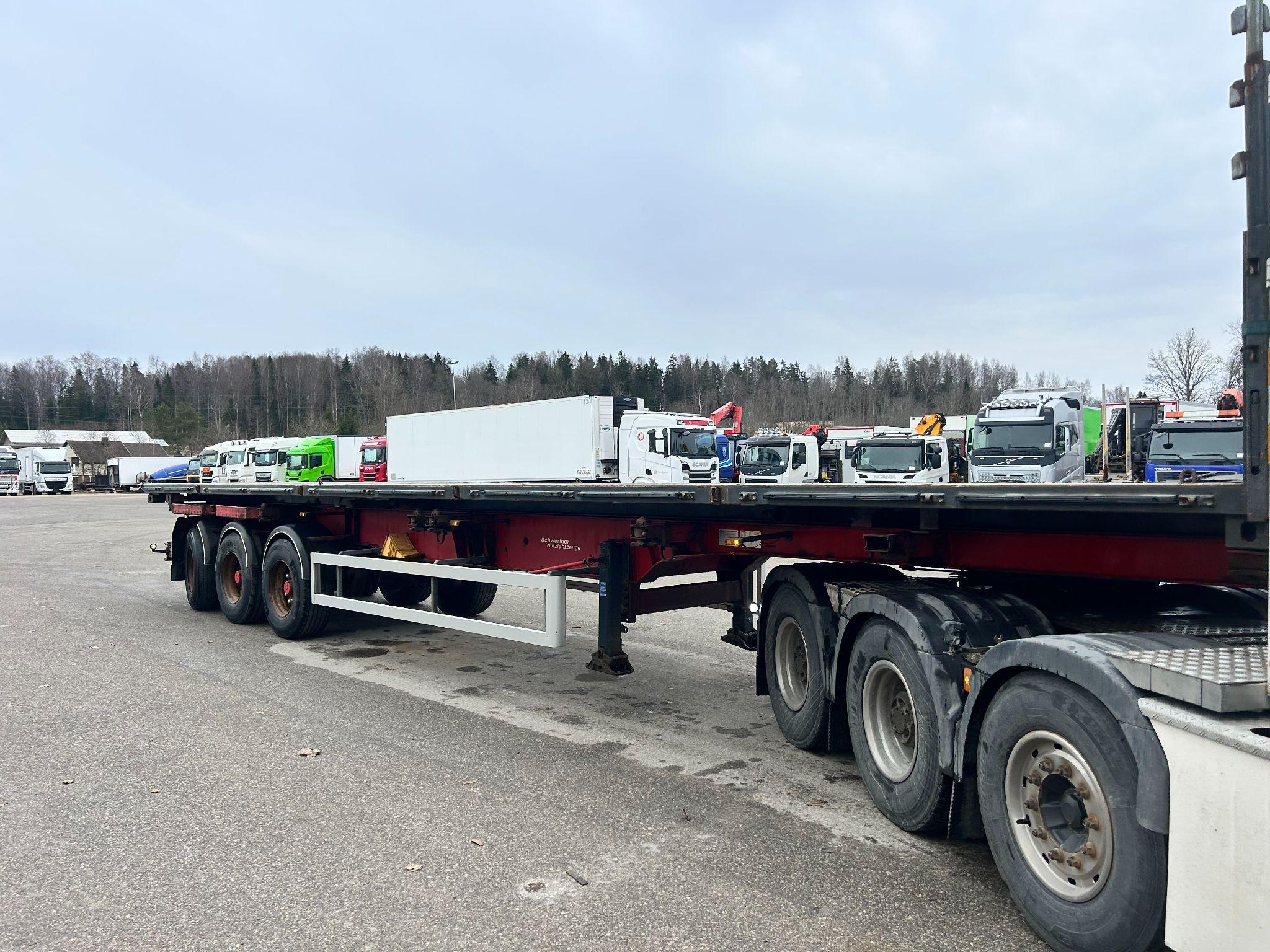
The frame, suspension, mounting areas and landing legs need close inspection; a general side view cannot establish their condition.
2. Tyres, Hubs and Suspension: Find the Cause, Not Just the Symptom
Inspect every tyre, not only the easily visible outer sidewalls. Record the size, load rating, manufacturing date, tread condition and any cracking, cuts, bulges or exposed reinforcement. Age is useful context, but it should be considered alongside physical condition and the tyre manufacturer's guidance rather than used as a universal replacement deadline.
The important purchasing distinction is between normal wear with a defined replacement cost and an unexplained wear pattern. If the tyres need replacement but inspection finds no underlying problem, you can obtain a quote and include it in the deal. If one edge is heavily worn or wear differs unusually between wheels, have pressures, alignment and suspension condition investigated before assuming a new set of tyres completes the work.
Read the suspension together with the tyres. On an air-suspended trailer, inspect visible air bags for damage and ask for a demonstration of the system at its specified running height. A trailer photographed with its suspension lowered is not automatically defective, but one that cannot maintain the correct height during a proper check needs investigation.
Shock absorbers, bushes, suspension arms and mountings also matter. On mechanical spring suspension, include spring leaves, hangers and axle attachments in the workshop inspection. Any fitted lift or steering axle should be checked according to its operating conditions, not dismissed as faulty because it does not move in an unsuitable test setup.
Look around the hubs for leakage, damaged seals and signs of overheating. A leaking hub does not identify the exact failed component, and a rumbling noise is not proof of bearing failure. Ask a technician to establish the condition of the hub and bearings using the correct inspection procedure.
For your budget, request a quote for the confirmed repair, not just the visible symptom: tyres plus any necessary alignment work, or a hub repair including any affected components.
3. Brakes and Electrics: Ask What Was Actually Tested
“The brakes have been checked” can mean anything from a glance at the dashboard to a measured brake-performance test. Ask the seller to distinguish the evidence.
A mechanical inspection should establish the condition of the fitted disc or drum brakes, pads or linings, operating components, air lines, reservoirs and mountings. Recently fitted pads do not establish the condition of the rest of the system.
Where electronic braking equipment is fitted, a diagnostic check can identify active and stored faults. A warning-lamp check is not the same as reading the diagnostic history, and stored codes need interpretation: they may relate to previous repairs rather than a current defect. Equally, “it is probably only a sensor” is not a diagnosis on which to base the repair budget.
A brake-performance test measures how the brakes perform. Ask for a recent report identifying the trailer and have a workshop explain the results, including any imbalance, binding or limitations caused by test conditions. The purpose is not just to see a pass mark but to understand whether anything needs further attention.
These checks complement one another. An electronic system can report no active faults without proving that every mechanical component is within its wear limits. A previous test result is useful evidence, not a guarantee of the trailer's present condition.
Test the road lighting separately using a suitable electrical connection. Check the rear lights, indicators, side markers and other required lights, together with plugs and accessible wiring. A failed lamp with an identified cause is a different repair from intermittent faults spread across several circuits. Powered tail lifts and other additional electrical equipment need their own checks.
Before agreeing a price, establish whether the seller will repair and retest any braking faults or whether you are buying a trailer that needs workshop work before collection or operation.
4. Floor and Body: Check What Happens During Loading
There are two separate questions: can the trailer carry your cargo, and can its floor support the equipment used to load it? A total payload figure does not answer both.
Where forklifts enter the trailer, request the applicable floor-loading rating, including the permitted forklift axle load where specified. Compare it with the loading equipment as actually used, not just the forklift's empty weight. Pay close attention to the rear entry area and wheel paths exposed to repeated loading.
On wooden or composite floors, look for soft or damaged areas, loose fixings, water damage and repairs. Steel and aluminium floors need checks for deformation, cracks and corrosion as applicable. The supporting crossmembers must also be inspected from safe access: sound-looking boards do not establish the condition underneath.
A replacement floor panel may be a manageable repair when its supports are sound. The same visible damage can mean a much larger job if it extends into the crossmembers or reflects ongoing water ingress. Ask whether the estimate covers only the floor surface or also the supporting structure and the source of the damage.
For curtainsiders, demonstrate the roof mechanism, curtains, tensioners, posts and door operation. For box bodies, check panels, rear-frame alignment and seals. Inspect the rated load-securing arrangements required for your cargo; functioning curtains or doors do not, on their own, establish that the load can be secured appropriately.
The aim is to confirm both condition and capability. A neatly repaired floor is not a useful purchase if it is unsuitable for the loading method your customer uses.
5. Check the Equipment Specific to the Trailer Type
Once the common checks are complete, concentrate on the systems that make this particular trailer useful. A satisfactory axle and brake inspection does not establish the condition of a refrigeration unit, hydraulic ramp or extending frame.
Low-Loaders: Deck Capacity and Ramp Capacity Are Different
For used low-loader semi-trailers, verify the machinery's loading requirements against the deck, ramps and permitted load distribution. Confirm what the ramp rating actually covers, including whether it is stated per ramp or for the pair and any relevant operating limitations. Width, loading angle and machinery ground clearance can be as important as total weight.
Inspect ramp surfaces, hinges, pins, mountings and transport locks. Have the seller demonstrate the hydraulics and any steering or extending functions safely according to the manufacturer's instructions. Do not arrange an improvised overload test. An unloaded demonstration shows movement, not proof of rated load capacity.
When movement is uneven, a lock does not engage or a leak is visible, establish the cause and required work before budgeting. Buying from abroad makes a current demonstration and supporting records particularly valuable, but a video does not replace a specialist assessment of suspect components.
Container Chassis: Check the Configuration You Will Actually Use
Confirm the supported container lengths, twistlock positions and permitted loading arrangements. Two chassis described as suitable for the same container length may still differ in how the container can be positioned and loaded.
On sliding or extendable designs, ask for a demonstration of the movement and positive locking in the positions you need. Inspect twistlocks, locking pins, guides and visible structural areas. A chassis that moves but does not lock correctly has not passed the relevant check.
Use the listings for used container frame semi-trailers to shortlist suitable layouts, then confirm the individual trailer's specification rather than relying on its general category description.
Refrigerated Trailers: Starting the Unit Is Not a Cooling Test
Assess the refrigeration unit, insulated body and normal running gear separately. Request the unit's model and serial details, operating hours, available service records and alarm information, then inspect the body, floor and door seals for damage.
Check the refrigeration unit and insulated body separately from the trailer’s axles, suspension and brakes.
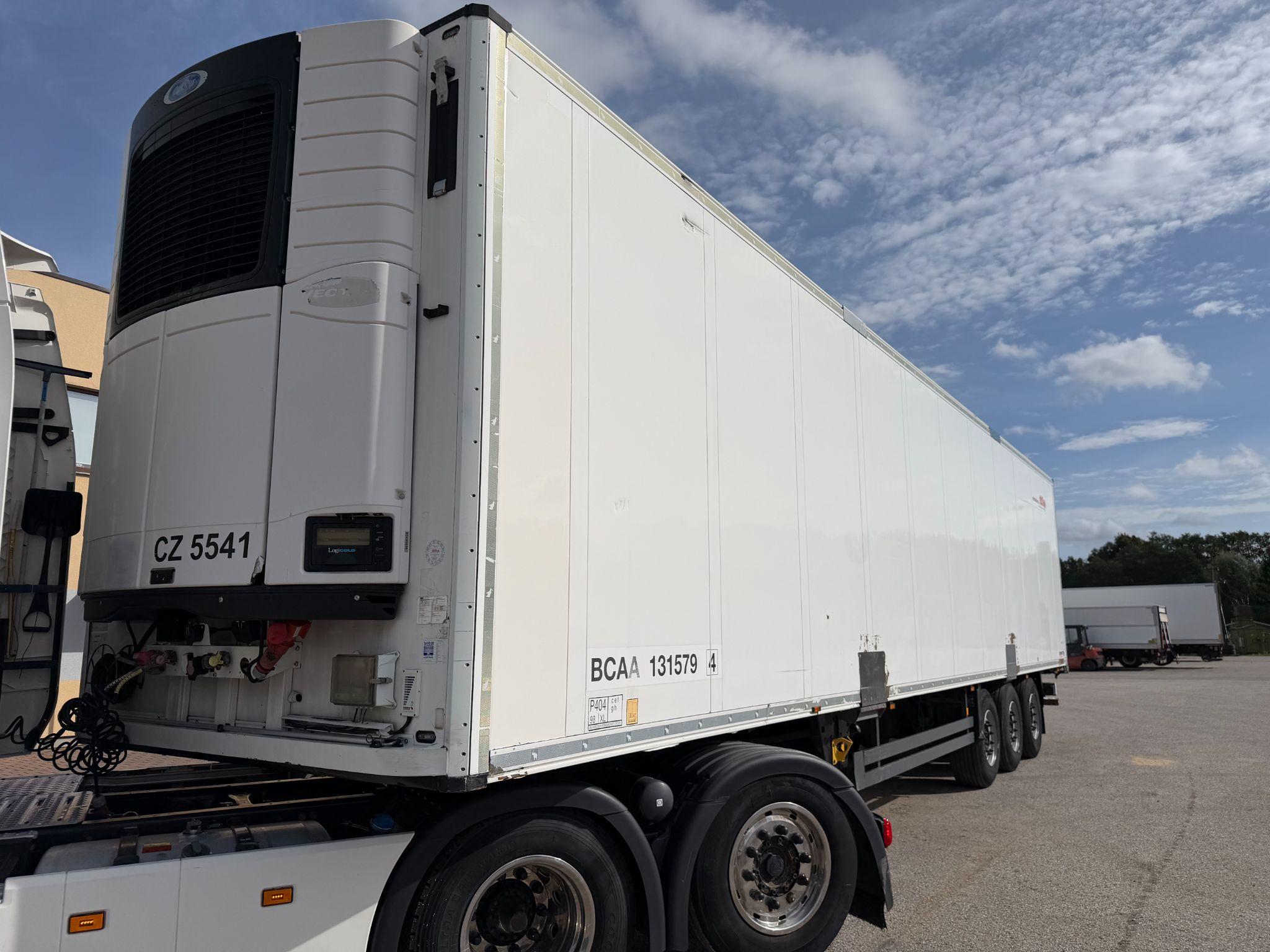
A controller's setpoint is the requested temperature, not the measured compartment temperature. A photograph showing a selected target does not establish that the trailer has reached it.
Request an appropriate functional test and any manufacturer-provided pre-trip results. For a cooling demonstration, ask for the starting and measured temperatures, ambient conditions, elapsed time and operating mode. Confirm which compartment is being measured on a multi-temperature unit and which power source is being tested, where alternatives are fitted.
An empty-body demonstration is not proof of performance under every operating condition. If temperatures do not respond as expected or alarms remain unresolved, obtain a refrigeration specialist's assessment before assigning a repair allowance. Do not treat an engine that starts as proof that the complete refrigeration system works.
6. History and Documents: Match the Evidence to the Trailer
Ask about previous cargo, operating environment and major repairs. Maintenance records are most useful when they can be linked to the trailer or equipment by VIN, serial number, date and a clear description of the work. “The brakes were done recently” is less useful than an invoice showing what was replaced and a subsequent test report.
Missing history is not automatic evidence of neglect. It does mean that claims about previous work need more verification and that the present inspection carries greater weight. Give particular attention to major structural repairs and specialist equipment whose repair costs remain uncertain.
Check the seller's authority to sell, the ownership documentation and any finance restrictions. For an international purchase, confirm the documents needed for your chosen transport method and destination before payment. Do not assume that a local inspection certificate settles registration or operating requirements elsewhere.
Agree the handover condition in writing: what is included, which defects have been disclosed, which repairs will be completed, what evidence will be supplied afterwards and when the trailer can be collected. A trailer sold for repair and one supplied ready for work should not be evaluated as the same offer.
7. Decide What to Price and What to Investigate First
The following distinctions help turn inspection findings into a purchase decision. They are not permission to operate a defective trailer.
| Finding | What must be established | Buying decision |
|---|---|---|
| Tyres need replacement, with no unresolved abnormal wear | Correct replacements and the complete fitted price | Include the confirmed cost and compare the overall deal. |
| Uneven tyre wear or an unusually low corner | Cause, affected components and any alignment work | Diagnose before assuming tyres or one air bag will solve it. |
| Braking warning or unsatisfactory performance | Diagnostic findings, mechanical condition and the repair-and-retest scope | Resolve the uncertainty before committing on a ready-for-work basis. |
| Damaged or repaired floor | Condition of supports, source of damage and required floor rating | Price an isolated repair only after the wider scope is understood. |
| Cracks, distortion or doubtful repairs near load-bearing or coupling areas | Repairability and suitability, assessed by a qualified specialist | Pause the purchase decision until those questions are answered. |
| Hydraulic or refrigeration equipment moves or starts but is not fully demonstrated | Relevant functional results, limitations and outstanding faults | Do not value it as verified working equipment. |
| Missing records or inconsistent identification | What can be verified and whether identity and ownership are clear | Missing service records may be manageable; unresolved identity or title issues must be settled first. |
A trailer needing repairs can still be a worthwhile purchase when the work is understood, feasible and reflected in the price. The greater concern is a deal that only looks affordable because the repair scope is unknown. Safety-critical defects must be rectified and the trailer's suitability verified before operation.
8. Compare the Cost of Putting Each Trailer to Work
Compare trailers with equivalent capabilities and intended handover conditions. When looking at Kässbohrer semi-trailers and HFR trailers, identify the individual model, axle and brake equipment, loading arrangement and required repairs. A quote based on the actual components is more useful than a general assumption about which brand is cheaper to maintain.
Consider this illustrative example, not a repair-price estimate. Trailer A costs €20,000 and needs €3,500 of confirmed work. Trailer B costs €22,000 and needs €500 of confirmed work. Before other comparable expenses, their totals are €23,500 and €22,500 respectively: the higher-priced trailer costs €1,000 less to put into the agreed condition.
That calculation only works if the quotes cover the required work. An uninvestigated hydraulic fault entered as “€500 allowance” is not equivalent to a workshop quotation. Include inspection or retesting, transport, registration and any planned modifications, and compare figures on the same VAT basis. Account separately for workshop time when it affects a contract start date.
Before negotiating, ask the workshop to separate necessary work from optional improvements and to identify anything it cannot price without further investigation. Then agree who carries out the work and what happens if the findings change.
Used Semi-Trailer Inspection Checklist: 10 Things to Check
Before inspecting a trailer in detail, use this quick checklist to identify potential problems. It covers the main areas that should be examined before making a purchase.
- Tyres: Check tread depth, uneven wear, cracks and tyre age.
- Brakes: Inspect brake components, air lines and EBS/ABS operation.
- Wheel bearings: Look for hub leaks, unusual noises and excessive wheel play.
- Suspension: Check air bags, shock absorbers, springs and axle alignment.
- Frame and chassis: Look for cracks, corrosion, deformation and previous repairs.
- Electrical system: Test lighting, connectors, wiring and electronic braking systems.
- Flooring: Inspect the loading surface for damage, weak areas and excessive wear.
- Ramps and moving parts: Check hinges, locking mechanisms and hydraulic operation.
- Previous ownership: Verify registration details, maintenance records and previous use.
- Price: Compare the asking price with the trailer's condition and expected repair costs.
This checklist is a starting point rather than a replacement for a professional inspection. Braking systems, wheel bearings and structural damage may require specialist equipment to assess properly.
The Final Buying Test
A good used semi-trailer does not have to be the newest or the best-looking option. It needs to suit the job, have an adequately established condition and make financial sense once the necessary work is included.
Before committing, you should be able to explain what is ready for use, what needs repair, what the repair costs cover and whether any important question remains unanswered. If you cannot explain why a low price is justified, investigate before treating it as a bargain.
Explore Engeros's selection of used trailers for sale to compare suitable configurations, then request the specification and condition information relevant to the individual trailer you are considering.
Frequently Asked Questions
What should I check first when buying a used semi-trailer?
▶
First, confirm that the trailer's specifications, permitted weights and loading arrangements suit your transport requirements. Then inspect the chassis, coupling, brakes, suspension, axles and tyres. These components affect safety and can be expensive to repair if serious problems are found.
How can I tell if a used semi-trailer is in good condition?
▶
Look for a structurally sound chassis, properly functioning brakes, even tyre wear and well-maintained suspension and loading equipment. Check the available service records and inspection reports. A professional inspection can reveal mechanical or structural problems that are not visible during a basic walk-around.
Is a valid technical inspection certificate enough when buying a used semi-trailer?
▶
No. A valid technical inspection certificate provides evidence of the checks completed at the time of inspection, but it does not guarantee the trailer's current condition. It may not establish floor-loading capacity, refrigeration performance or upcoming repair costs. Review the certificate alongside the trailer's maintenance history and present condition.
Should I avoid buying a semi-trailer with rust or previous repairs?
▶
Not necessarily. Surface rust and properly completed repairs do not automatically make a trailer unsuitable. However, deep corrosion, cracks or questionable repairs affecting the chassis, coupling or other load-bearing areas require professional assessment. Ask for repair records and establish whether the structure remains suitable for its intended use.
What documents should I check before buying a used semi-trailer?
▶
Verify the registration documents, vehicle identification number (VIN), identification plate and seller's authority to sell. Request available maintenance records, previous inspection reports and invoices for major repairs. Check for outstanding finance or ownership restrictions. International purchases may require additional transport and registration documents.
Can I buy a used semi-trailer without a complete service history?
▶
Yes, provided its identity and ownership are clear and its condition can be assessed satisfactorily. Missing records do not necessarily indicate poor maintenance, but they increase uncertainty about previous repairs and servicing. Arrange a more detailed inspection and avoid treating undocumented repairs as verified work.
What should I request when buying a used semi-trailer remotely?
▶
Request recent photographs of the chassis, tyres, suspension, flooring and any areas showing damage or repairs. Ask for identification documents, technical specifications, maintenance records and relevant inspection reports. Videos demonstrating hydraulic ramps, refrigeration units or other fitted equipment can also help, but they do not replace a professional inspection.
Is it worth buying an older or cheaper semi-trailer that needs repairs?
▶
It can be, if the trailer is suitable for your work and the necessary repairs are clearly identified, feasible and reflected in the price. Compare the purchase price plus repairs, transport and registration costs with an equivalent trailer requiring less work. An older, well-maintained trailer may offer better value than a newer one with unresolved mechanical problems.
Should I buy a used semi-trailer from a dealer or a private seller?
▶
Both options can be suitable. Compare the available documentation, opportunities for inspection, sales terms and the seller's responsibilities. Establish which repairs, inspections or other services are included before payment. The individual trailer's condition and the agreed handover terms matter more than the seller category alone.
What are the most expensive problems to repair on a used semi-trailer?
▶
Major chassis damage, extensive floor repairs and faults involving specialised hydraulic or refrigeration equipment can be particularly expensive. Serious braking, axle or suspension problems may also increase the total purchase cost. Obtain workshop estimates for significant defects and investigate any faults whose repair scope remains unclear before committing to the purchase.