Volvo FH vs Scania R: Which Used Truck Should You Buy?
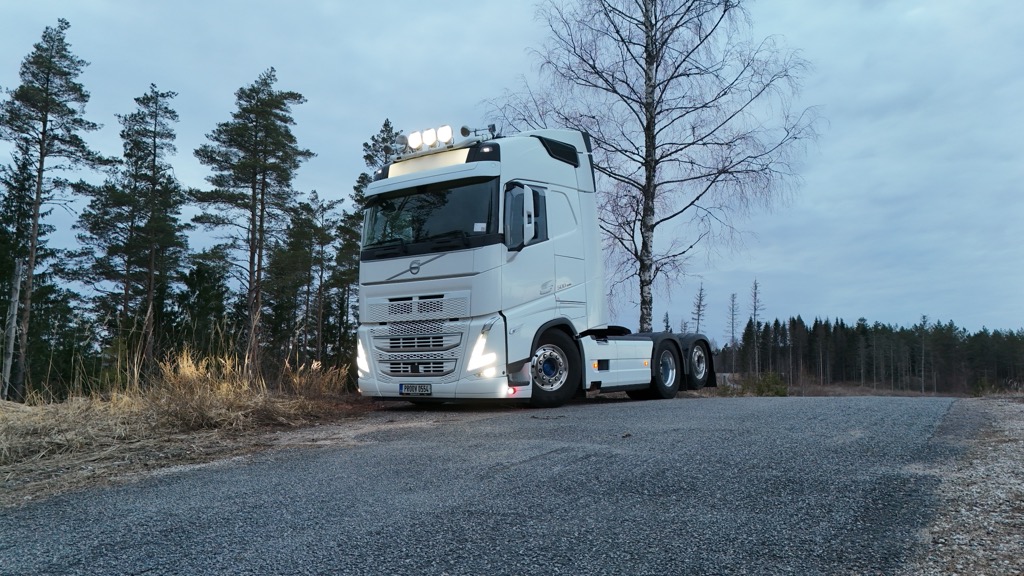
You have found a Volvo FH and a Scania R with similar mileage and asking prices. Both look suitable for the job. The Volvo advert highlights I-Shift; the Scania has a retarder and a Highline cab. Which one deserves your money?
“Both are good trucks” does not help much. Neither does a comparison that describes Volvo as comfortable and Scania as powerful without explaining which versions are being compared.
The useful differences are more specific. Two trucks with “500” on the cab can have different engines and torque outputs. An efficiency package may justify a higher price for a truck covering 150,000 kilometres a year, but not for one covering 50,000. A particular gearbox, cab or axle option can also make one vehicle a better fit for your work.
This guide focuses on used diesel Volvo FH and Scania R trucks, with particular attention to tractor units. The aim is to identify the differences worth paying for—and those that should not decide the purchase.
Which Would We Shortlist First?
For high-mileage motorway work, our starting shortlist would be a Volvo FH460 or FH500 with verified I-Save specification, alongside a Scania R460 or R500 with the Super powertrain. Both are deliberately developed around long-haul efficiency, rather than simply offering a particular horsepower rating. I-Save was introduced in 2019; Scania launched its new Super powertrain in November 2021. Those features should not be assumed from the FH or R badge alone.
For a tighter purchase budget or lower annual mileage, we would also consider a conventional D13-powered FH or a pre-Super six-cylinder Scania R. The decision here is whether the more expensive truck can earn back its premium during your ownership—not whether its technology is newer.
A Scania R V8 belongs on a different shortlist when you specifically need the performance of a higher-output engine, or deliberately want a V8-equipped truck. Volvo’s corresponding high-power alternative is the separate FH16 range, not simply an ordinary FH500 with more options.
These are starting recommendations, not rankings of every truck carrying those badges. The first step is to establish exactly what each vehicle is.
FH500 vs R500: The Badge Does Not Tell the Whole Story
One of the most useful distinctions in the used market is also easy to miss: an R500 is not necessarily a V8, and an FH500 is not necessarily an I-Save truck.
Older R500 versions used a 15.6-litre V8. Later versions include a 13-litre-class six-cylinder engine, followed by the newer Super engine. Volvo also offered different 500 hp engines with materially different torque outputs.
The following manufacturer specifications show why comparing horsepower alone is inadequate:
| Specific version | Engine | Maximum engine torque | What matters to the buyer |
|---|---|---|---|
| Volvo FH500, standard D13K | 12.8-litre inline-six | 2,500 Nm | Do not value it as an I-Save truck merely because it has I-Shift. |
| Volvo FH500 I-Save, D13TC | 12.8-litre inline-six with turbocompound | 2,800 Nm | Same nominal horsepower, but substantially more low-speed torque than the standard D13K500. |
| Scania R500, pre-Super DC13 | 12.7-litre inline-six | 2,550 Nm | A six-cylinder R500, not the older V8 and not automatically a Super. |
| Scania R500 Super | 12.74-litre inline-six | 2,650 Nm | A newer powertrain generation that should be identified separately when comparing prices. |
| Older Scania R500, DC16 Euro 5 example | 15.6-litre V8 | 2,500 Nm | The V8 badge does not automatically mean more torque than a newer six-cylinder truck. |
These are representative factory ratings for the versions identified, not universal specifications for every FH500 or R500. Confirm the individual truck’s engine code and build specification.
There is a useful surprise here. The listed FH500 I-Save has 12% more maximum engine torque than the standard FH500. Volvo’s corresponding D13K540 specification lists 2,600 Nm—less peak torque than the 500 hp I-Save version, despite its higher horsepower.
That does not make the FH500 I-Save faster or better in every situation. Horsepower, the shape of the torque curve, gearbox ratios and final-drive gearing all contribute to performance. It does mean that dismissing a truck because another advert shows “540” rather than “500” can be a poor buying decision.
When comparing a Volvo FH500 with a Scania R500, ask for the engine specification before drawing conclusions from the model name.
I-Save vs Scania Super: When Is the Newer Powertrain Worth Paying For?
Volvo I-Save is not another name for I-Shift. I-Shift is the transmission; I-Save combines a turbocompound engine with efficiency-focused drivetrain features. The turbocompound system recovers energy from the exhaust and feeds it back mechanically, contributing to the engine’s stronger low-rev torque delivery. Volvo developed the package particularly for long-haul operators with high annual mileage.
Scania Super is also more than a badge or software setting. Its introduction brought a new 13-litre engine platform together with updated gearbox and axle technology. It should therefore be distinguished from an earlier six-cylinder R500, even when the cab and advertised horsepower appear similar.
For a truck spending most of its working life on long motorway routes, those differences deserve serious attention. For occasional transport, short contracts or low annual mileage, the purchase premium needs more scrutiny.
Put a Price on the Claimed Fuel Saving
Consider an illustrative calculation, not a measured Volvo-versus-Scania result.
Suppose the more expensive truck costs €10,000 extra, and comparable operating records suggest it could use 1.5 litres less per 100 kilometres in your work. At an assumed diesel cost of €1.40 per litre, a truck covering 150,000 kilometres annually would save:
150,000 ÷ 100 × 1.5 × €1.40 = €3,150 per year.
The additional purchase price would take approximately 3.2 years to recover through fuel savings alone.
At 50,000 kilometres annually, the same assumed difference saves only €1,050 per year, extending that simple payback period to approximately 9.5 years.
The calculation excludes financing, AdBlue, maintenance, downtime and resale value. Its purpose is to show why the same truck can be a sensible upgrade for one operator and an unnecessary expense for another.
Our buying preference: give an I-Save FH or Super Scania greater weight in a high-mileage operation, but do not pay a large premium on the strength of an unverified fuel-saving claim. Request consumption records covering comparable loads, routes and speeds—not one favourable dashboard photograph.
Manufacturer improvement percentages also need context. A saving measured against a manufacturer’s previous powertrain is not proof that it beats the other brand by that percentage.
I-Shift vs Opticruise: Which Gearbox Differences Can You Actually Feel?
“I-Shift” and “Opticruise” describe transmission families, not a single unchanged gearbox. The useful comparison is between the actual versions fitted to the two trucks.
Volvo’s I-Shift Dual Clutch is a specific option, not a feature of every I-Shift vehicle. It can maintain torque delivery during individual gear changes, apart from the range change between sixth and seventh; when skipping gears, it can shift in the manner of a conventional I-Shift. Its advantage is particularly relevant when frequent changes would otherwise interrupt progress under load.
That gives a buyer a concrete reason to prefer a particular FH: regular loaded driving on rolling roads, combined with a demonstrable preference for its shifting behaviour. It is not a reason to assume every Volvo changes gear more smoothly than every Scania.
On the Scania side, identify whether the vehicle has an earlier gearbox or a newer G25CM/G33CM-family unit. Scania’s newer gearbox architecture includes a wider ratio spread and changes aimed at reducing internal losses. Importantly, G33CM was also available with certain pre-Super 500 and 540 hp six-cylinder engines, so the engine generation and gearbox generation should be checked separately.
Some Scania specifications also offered Clutch on Demand, allowing the driver to use an additional clutch pedal for particular manoeuvres while retaining automated operation otherwise. This can matter in specialist work; the presence of a third pedal does not always mean the truck has an ordinary manual gearbox.
For a fleet tractor, test the things drivers repeatedly do: moving away, reversing towards a loading position and accelerating through normal gear changes. A sophisticated gearbox option is only worth paying for when it suits the job and operates correctly.
Cab Comfort: There Are More Useful Differences Than “Both Are Spacious”
Globetrotter, Globetrotter XL and Scania Highline should not be treated as interchangeable descriptions of a large cab.
For example, the manufacturer brochures referenced here show 2,110 mm of standing height over the engine cover in the Volvo Globetrotter XL, compared with 1,915 mm at the centre of the Scania R high-roof cab. Those measurements apply to the illustrated cab versions, but they demonstrate a meaningful difference for a tall driver who spends nights in the vehicle.
The Scania R should also not be confused with the S-series flat-floor cab. Scania introduced the new R and S cab generation in 2016, with the flat-floor arrangement belonging to the S-series. Someone choosing an R500 because they liked the interior of an S500 may be comparing the wrong cabins.
Volvo has another option worth testing rather than merely reading about: Volvo Dynamic Steering. When fitted, it provides additional steering assistance and reduces steering kicks from road irregularities. For a driver doing repeated yard manoeuvres or spending long periods at the wheel, this can be a tangible reason to prefer that particular FH over a truck without equivalent assistance. It is not fitted to every FH.
Our recommendation is to let the intended driver assess both cabs with the seat properly adjusted. Check movement between the seats and bed, storage access, mattress condition and the fitted heating and cooling equipment. For overnight work, a cab that functions well in practice is more valuable than an impressive trim name.
Heavy Loads: When Does a Scania V8 Make Sense?
A V8 should solve an operating requirement, not simply win an argument about prestige.
Scania offers R-series V8 specifications with power and torque beyond the standard six-cylinder range. That makes the higher-output versions relevant when the operation genuinely needs that performance. However, the older R500 V8 example in the table also shows why “V8” alone is not a performance comparison: its maximum torque is below that of the listed FH500 I-Save.
For normal road freight, our starting point would be a suitable six-cylinder truck. We would move towards a higher-output V8 or Volvo FH16 when the load and route justify it, rather than buying excess engine capacity before deciding what work the truck will perform.
For specialist heavy haulage, the comparison must extend to the whole drivetrain. A high-power engine does not compensate for unsuitable axle ratings, gearing, coupling equipment or an inadequate approved combination weight.
Do Not Confuse Engine Braking With a Retarder
A Volvo advertised with VEB+ has an engine-braking system; that description does not establish that it also has a separate retarder. Equally, a Scania without a listed retarder may have more than a basic exhaust brake: the Super engine can be equipped with an optional compression-release brake rated at up to 350 kW.
For sustained loaded descents, identify the actual auxiliary braking equipment rather than assuming that one brand automatically has the stronger arrangement. Scania itself distinguishes applications where its Super engine brake may be sufficient from heavier duties where a retarder remains important.
Our preference on a demanding downhill route is the truck with the appropriate verified braking specification—not necessarily the one with the highest horsepower.
Tippers, Hooklifts and Crane Trucks: The Equipment Can Reverse the Decision
A useful Volvo-specific example is Tandem Axle Lift, available on selected configurations. It can disengage and lift the second driven axle when it is not needed. Volvo developed the function for work such as carrying a load in one direction and returning empty. This is different from simply having a non-driven lift axle on a 6x2 truck.
For an operator with frequent empty return journeys, an FH equipped with this system deserves a closer look than an otherwise comparable truck without it. The feature is relevant because of the work pattern, not because all Volvo axles are inherently better.
The decision can just as easily favour a Scania when its installed equipment better matches the contract. Suppose one truck already has the required hooklift capacity, body length and hydraulic arrangement, while the other needs modification. Our first step would be to price and assess that conversion before comparing fuel-saving options or cab extras.
The same applies to a crane truck: the required reach and lifting capacity are non-negotiable selection criteria. A preferred chassis brand is not a substitute for the correct lifting equipment.
For specialist vehicles, choose the working equipment and chassis combination first. Use the FH-versus-R comparison to decide between vehicles that can actually do the same job.
Reliability and Maintenance: Do Not Pay for a Reputation Instead of Evidence
A higher asking price should buy something identifiable: a newer powertrain, useful equipment, documented repairs, better condition or stronger support for your operation. It should not be justified only by “Scanias last longer” or “Volvos are cheaper to maintain”.
Rather than trying to predict an entire model range’s reliability from its badge, compare the financial exposure of the actual trucks. Ask a workshop familiar with each vehicle to price the work identified during inspection, explain what servicing is approaching and identify any unresolved diagnostic issues.
Keep different technologies separate in that assessment. The I-Save engine includes a turbocompound unit; Scania Super uses its own engine and Twin-SCR aftertreatment arrangement. These are differences in the hardware being purchased, not evidence that either system is inherently unreliable. They are reasons to obtain support and maintenance information for the exact engine version.
Local workshop access can also be a legitimate tie-breaker. If your existing technicians, diagnostic equipment and parts supply already support one brand, include the cost of introducing the other. A modest purchase saving is less persuasive when it creates additional maintenance complexity.
For the broader inspection process, use our guide to buying a used truck from a dealer. Here, the important point is narrower: compare the cost of putting each candidate to work and keeping it there, rather than paying more for a general reputation.
Three Comparisons That Lead to Different Buying Decisions
A useful verdict needs to identify which trucks are being compared. The following are our starting recommendations for high-mileage road transport, assuming comparable age, condition, required equipment and purchase price.
FH500 I-Save vs a Pre-Super Six-Cylinder R500
We would investigate the FH500 I-Save first. Its turbocompound engine and higher low-speed torque give it a specific, relevant advantage to evaluate for this duty.
That is a shortlist preference, not proof of lower fuel consumption than the Scania. The R500 can still become the better purchase if its actual consumption records, maintenance position or support arrangements outweigh the Volvo’s technology advantage.
Scania R500 Super vs a Standard, Non-I-Save FH500
We would investigate the R500 Super first. Its newer efficiency-focused powertrain gives it a more compelling case for intensive long-haul use than comparing the two “500” badges would suggest.
Again, the preference comes from the specific powertrain—not from a claim that every Scania beats every Volvo.
FH500 I-Save vs Scania R500 Super
Here, neither technology label alone settles the purchase. We would compare the operating records and calculate the cost difference over the intended ownership period.
For these closer candidates, the most useful tie-breakers are the driver’s cab assessment, the actual gearbox and auxiliary braking equipment, upcoming workshop expenditure and the support already available to the business.
These recommendations follow from the manufacturers’ identified powertrain differences; they are not the result of a controlled head-to-head test of two used vehicles.
For lower annual mileage, we would be less willing to pay a large premium for either efficiency package. The fuel-payback example explains why.
The Verdict: Buy the Difference That Will Matter in Your Work
Choose a Volvo FH when the particular vehicle offers an advantage you will use—such as an attractively priced I-Save powertrain, a preferred Dual Clutch transmission, Dynamic Steering, suitable Globetrotter XL accommodation or Tandem Axle Lift for the right work pattern.
Choose a Scania R when its particular specification makes the stronger case—such as a well-priced Super powertrain, the V8 performance your operation requires, a suitable newer Opticruise installation or a better-equipped specialist vehicle.
Do not pay for all of those features merely because they exist. Pay for the ones that improve your operation, and check that the truck you are buying actually has them.
The question is not “Which brand has the longest specification list?” It is “What does this truck do better for my business, and is that difference worth the price?”
Browse Engeros’ available used tractor units, or contact our sales team with your typical load, annual mileage, routes and budget to discuss suitable vehicles.
Frequently Asked Questions
Is every Scania R500 a V8?
▶
No. Older R500 versions include a 15.6-litre V8, while later R500 trucks include six-cylinder DC13 engines and the newer Super version. Confirm the engine code and production specification rather than relying on the model badge.
Is an FH500 I-Save more powerful than an FH540?
▶
Not in rated horsepower. However, the FH500 I-Save specifications discussed here show 2,800 Nm of maximum torque, compared with 2,600 Nm for the corresponding standard D13K540. Higher peak torque and higher rated power are different characteristics; neither figure alone establishes which complete truck will perform better on your route.
Does I-Shift mean a Volvo has Dual Clutch?
▶
No. Dual Clutch is a specific I-Shift variant. Standard I-Shift, Dual Clutch and crawler-gear configurations should be identified separately when checking a used vehicle’s specification.
Should I pay more for I-Save or Scania Super?
▶
For high annual mileage, an additional investment can make sense when credible operating data supports the expected saving. At lower mileage, the same purchase premium takes much longer to recover. Calculate the saving using your own distance, fuel cost and ownership period, then account for maintenance and resale rather than deciding from the badge alone.